
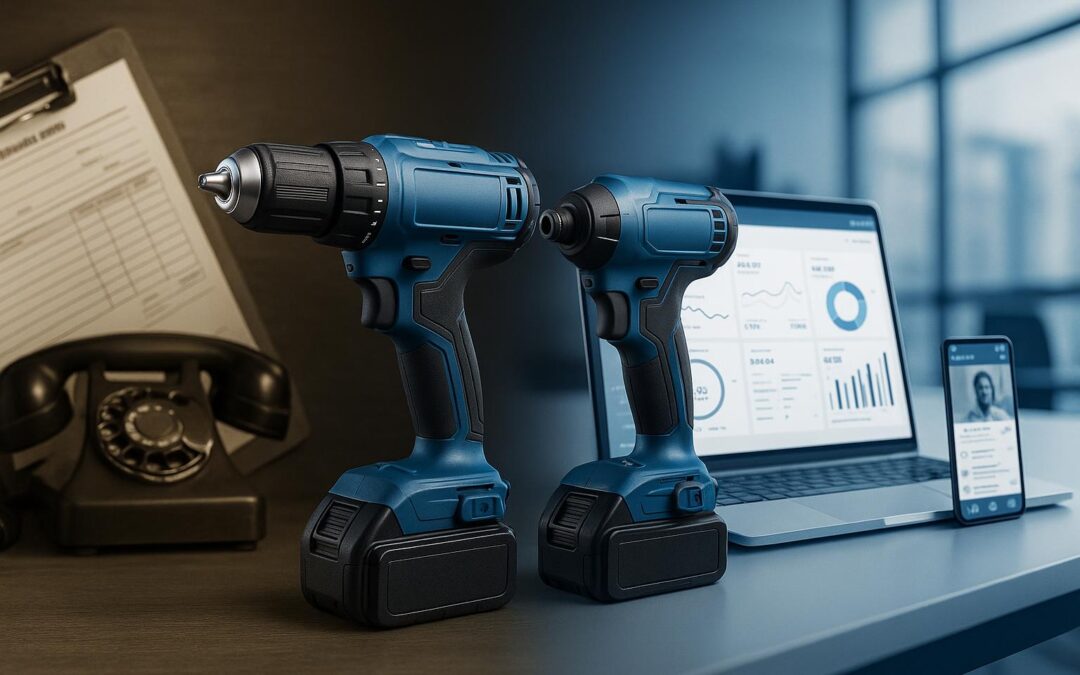
Imagine you hire a master craftsman for an important project. He shows up with a rusty toolbox containing a hammer with a wobbly handle and a dull saw. When you ask why he isn’t using professional power tools from brands like Makita or Bosch Professional, he replies, “I’ve always done it this way; it works just fine.” Would you trust this craftsman? Probably not. You expect a professional to work with professional tools to achieve the best possible result.
So why do we often accept behavior in sales that would be unthinkable in any other professional environment? Many sales representatives cling to outdated methods and refuse to use modern tools like CRM systems, Artificial Intelligence (AI), or marketing automation platforms. This article argues that a modern, professional self-image in sales is inextricably linked to the willingness to use the best available tools to achieve maximum success.
The “Tie and Clipboard” Era: The End of an Age
Let’s recall the recent past, the era of what we might call “Tie, Clipboard, and Company Car” sales. These were the status symbols and work tools of the successful field sales representative. The arsenal was supplemented by the telephone, printed flyers, and the classic mail merge letter. In their time, these were the best tools available, and the sales professionals who mastered them were rightly successful.
But the world has moved on. Digitalization has not only created new communication channels but also offers tools that provide an efficiency and precision the old-school salesperson could only dream of. Holding on to these old methods is not a sign of tradition, but of stagnation. It’s as if a modern craftsman were still trying to drill a hole in a reinforced concrete wall with a hand drill.
The Mindset of the Modern Sales Professional
A professional self-image, regardless of the profession, is based on the aspiration to deliver excellent results. A surgeon uses the most advanced surgical instruments, a pilot relies on highly sophisticated avionics systems, and an architect works with powerful CAD software. The goal is always the same: to make optimal use of the available resources to minimize errors and maximize success.
This is precisely the standard that must apply to sales. The goal is maximum sales success. A modern sales professional, therefore, sees themselves as a craftsman who has mastered their trade—and this includes, inseparably, the selection and application of the best tools. Consciously deciding against more efficient, data-driven, and automated methods is not a sign of individuality, but a neglect of professional duty.
The Reality: Resistance to Modernization
Despite the obvious advantages, resistance to the adoption of digital tools in sales is widespread. A study by Dooly shows that sales representatives spend an average of only 28% of their time actually selling. The rest is spent on administrative tasks, data maintenance, or searching for information—activities that could be drastically reduced with modern tools 1.
The reasons for this resistance are varied and often humanly understandable. According to an analysis by Mittelstand-Heute.com, they primarily include:
Employee Fears: Sales representatives might fear that their work will be permanently monitored with a CRM system. Or that only quantitative figures will be rewarded, rather than the quality of their work 2.
Other reasons include the power of habit, the fear of leaving one’s comfort zone, and often bad experiences with poorly implemented, non-user-friendly systems in the past. Here, it is the responsibility of leadership to take these fears seriously and to frame the introduction of new tools as a change process that focuses on the benefits for the individual employee.
The Modern Sales Arsenal: Today’s Professional Tools
The modern sales toolbox is fully stocked. In place of clipboards and mail merge letters, we now have integrated systems that support the entire sales process. The following table provides an overview of the most important modern tools and their specific benefits.
| Tool | Description | Benefit for the Sales Professional |
| CRM System | The central database for all customer information, interactions, and sales opportunities. | 360-degree view of the customer, no lost information, better team collaboration. |
| Marketing Automation | Platforms for automated, personalized customer communication and nurturing processes. | Leads are systematically developed until they are sales-ready; saves time on cold calling. |
| LinkedIn / Social Selling | Professional networking, building expert status, and direct outreach to decision-makers. | Access to networks and information that remain hidden through traditional channels. |
| AI Tools & Agents | Artificial intelligence for analysis, forecasting, and automation. | Lead prioritization, more accurate forecasts, automated report generation, sentiment analysis in emails. |
| Videos & Podcasts | Modern content formats for customer acquisition and retention. | Stronger emotional connection, communication of complex topics, building a personal brand. |
The Business Case: Why Modernization Pays Off
The use of modern sales tools is not a matter of faith, but a hard-nosed business decision. The figures from practice speak for themselves:
•More Time for Selling: Generative AI can save sales representatives up to two hours of writing per week by automating emails, follow-ups, and reports 1.
•Higher Closing Rates: AI-powered guided selling, which prioritizes leads based on data, can increase closing rates by an average of 10-15% 1.
•More Accurate Forecasts: Predictive AI improves the accuracy of pipeline forecasts in medium-sized companies by up to 20%, significantly enhancing resource planning 1.
Those who refuse to use these tools are not only missing out on efficiency potential but will also lose their competitive edge in the long run.
Conclusion: The Responsibility of the Sales Professional
A professional self-image in 21st-century sales means using the best available tools to achieve the best possible results for the company and the customer. Resistance to digitalization, CRM, and AI is not a trivial matter; it contradicts the very core of professional standards. A salesperson who still proudly relies on their “gut feeling” and refuses to use data-driven tools is the craftsman with the cheap drill.
The question is not if modern tools should be used, but how they can be best implemented and integrated into daily work. It is time to finally shed the old-school sales mentality and embrace the professionalism that customers and employers rightly expect. Because true professionals use professional tools.
References
[1] Mittelstand-Heute.com. “AI in Sales: 12 Use Cases from Practice”.
[2] Mittelstand-Heute.com. “Introducing CRM: How to Increase User Acceptance”.